
Hearing loss doesn’t always affect every sound equally. Some people struggle with high-pitched noises, while others have difficulty hearing lower frequencies. But there’s another, less common pattern that primarily affects sounds in the middle of the hearing range.
Known as cookie-bite hearing loss, this condition can make everyday conversations difficult, even when certain sounds remain perfectly clear.
Understanding this unusual hearing pattern starts with a professional hearing assessment. At Melody Hearing Clinic, we help patients identify changes in their hearing and explore personalized solutions that support clearer communication.
What Is Cookie-Bite Hearing Loss?
Cookie-bite hearing loss, medically known as mid-frequency sensorineural hearing loss, occurs when a person has greater difficulty hearing middle-frequency sounds than lower- or higher-frequency sounds.
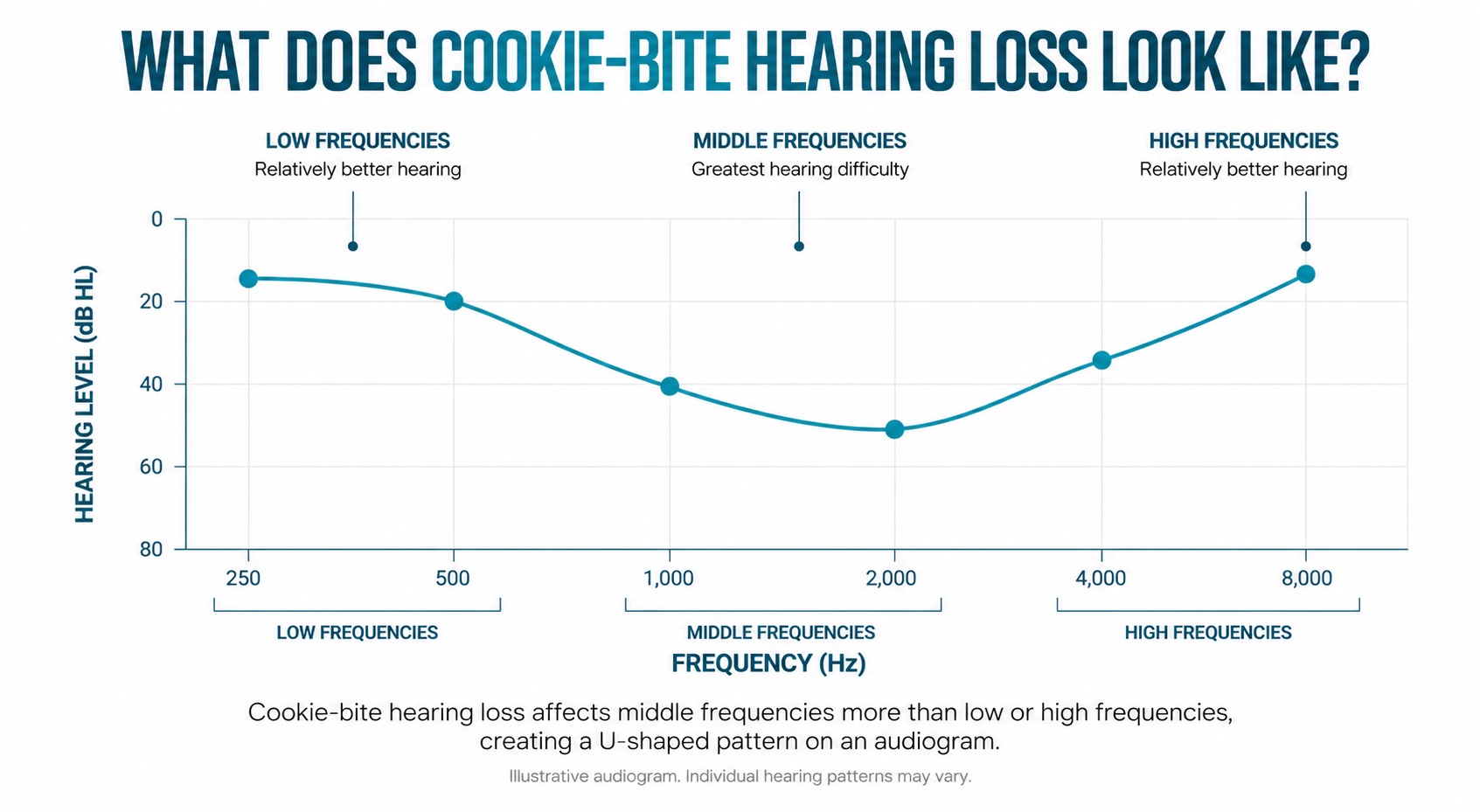
The condition gets its unusual name from the shape it creates on an audiogram, a graph used to display hearing test results.
Instead of showing a gradual decline toward higher frequencies, the audiogram forms a U-shaped curve resembling a bite taken out of a cookie.
These middle frequencies are particularly important for understanding speech. Someone with cookie-bite hearing loss may hear a person speaking but struggle to distinguish certain words or follow conversations clearly.
How Common Is Cookie-Bite Hearing Loss?
Cookie-bite hearing loss is relatively uncommon.
According to research published in the peer-reviewed journal Otology & Neurotology, mid-frequency sensorineural hearing loss has a reported prevalence of approximately 0.7%. The study, Characteristics of Mid-Frequency Sensorineural Hearing Loss Progression, examined the hearing patterns of 37 patients with the condition.
The 0.7% figure comes from earlier research cited in the study and is not a Canadian population estimate.
Although uncommon, cookie-bite hearing loss can affect people of different ages, including children and adults.
Recognizing the Symptoms of Cookie-Bite Hearing Loss
Because cookie-bite hearing loss affects specific frequencies, its symptoms can be difficult to recognize.
You may hear some environmental sounds clearly while struggling with conversations, especially when several people are speaking or background noise is present.
Common experiences include:
- Difficulty understanding speech, even when someone is speaking at a normal volume.
- Frequently asking people to repeat themselves.
- Struggling to distinguish certain words or speech sounds.
- Finding group conversations particularly challenging.
- Feeling tired after concentrating on conversations for extended periods.
These symptoms aren’t exclusive to cookie-bite hearing loss. Several other hearing conditions can cause similar difficulties, making professional testing important.
What Causes Cookie-Bite Hearing Loss?
Cookie-bite hearing loss is often associated with genetic factors, although its underlying cause isn’t always identifiable.
Certain inherited changes can affect how the inner ear processes middle-frequency sounds. In some cases, hearing difficulties begin during childhood, while others become noticeable later in life.
Other inner-ear or auditory conditions can occasionally produce a similar hearing pattern.
Importantly, a cookie-bite audiogram doesn’t automatically mean someone has inherited hearing loss. Research published in Otolaryngology–Head and Neck Surgery found that this audiogram pattern alone was not a reliable screening tool for identifying genetic variants associated with hearing loss.
Read the research on cookie-bite audiograms and genetic hearing loss.
Identifying the underlying cause may require additional medical evaluation, particularly when hearing loss develops suddenly, affects one ear more than the other, or occurs alongside other symptoms.
How Is Cookie-Bite Hearing Loss Diagnosed?
The most reliable way to identify cookie-bite hearing loss is through a comprehensive hearing assessment.
During a hearing test, a hearing care professional measures how well you detect sounds at different frequencies and volumes. These results are recorded on an audiogram.
Understanding the Cookie-Bite Audiogram
An audiogram displays hearing thresholds across a range of frequencies, from low-pitched to high-pitched sounds.
With cookie-bite hearing loss, the hearing thresholds are poorer in the middle frequencies, often around 1,000 to 4,000 Hz, while hearing remains relatively better at lower and higher frequencies.
This creates the distinctive U-shaped pattern.
The assessment may also include speech testing to evaluate how well you recognize and understand spoken words.
Together, these results help hearing care professionals determine the type, degree, and configuration of hearing loss.
At Melody Hearing Clinic, our professional hearing tests help identify hearing difficulties and provide guidance on appropriate next steps.
Treatment and Hearing Aid Options
Cookie-bite hearing loss doesn’t have a single treatment that works for everyone. The most appropriate approach depends on its severity, underlying cause, and impact on everyday communication.
For some people, hearing aids can improve access to sounds within the affected frequency range.
Unlike devices that simply increase overall volume, modern hearing aids can be programmed to provide different levels of amplification across specific frequencies.
This is particularly valuable for cookie-bite hearing loss because lower- and higher-frequency hearing may remain relatively strong.
A professionally fitted hearing aid can be adjusted to emphasize frequencies where additional amplification is needed while avoiding unnecessary amplification in other ranges.
Melody Hearing Clinic offers a variety of hearing aids and personalized fitting services to help patients find solutions suited to their individual hearing profiles.
Not everyone with cookie-bite hearing loss requires hearing aids. A professional assessment helps determine whether amplification, monitoring, or further medical investigation is appropriate.
Does Cookie-Bite Hearing Loss Get Worse Over Time?
Cookie-bite hearing loss doesn’t necessarily progress at the same rate for everyone.
In the previously mentioned Otology & Neurotology study, researchers found that most patients with mid-frequency sensorineural hearing loss experienced no clinically significant worsening during a median follow-up period of approximately four years.
However, the study involved a relatively small group of patients, and individual experiences can vary.
Regular hearing assessments can help identify changes over time and determine whether existing hearing care recommendations need to be adjusted.
Understand Your Hearing With Melody Hearing Clinic
If you’re having difficulty understanding conversations or noticing changes in how you hear certain sounds, a professional hearing assessment can help you understand what’s happening.
Cookie-bite hearing loss is only one of several patterns that can affect your hearing. Identifying the correct pattern is an important step toward choosing appropriate care.
At Melody Hearing Clinic, our hearing care professionals provide personalized assessments, explain your results, and help you explore solutions that fit your hearing needs and lifestyle.
Don’t let unclear conversations keep you from connecting with the people around you.
Book a hearing test with Melody Hearing Clinic and take the first step toward understanding your hearing health.