
Hearing aids are not always perfect the moment you first put them on. Fine-tuning is the process of adjusting your hearing aids so they better match your hearing needs, listening environments, and personal preferences.
A registered hearing aid practitioner can adjust features such as amplification, speech clarity, noise management, and listening programs based on your hearing test results and real-world experiences. The goal is not simply to make sounds louder. It is to make important sounds clearer and everyday listening more comfortable.
If your hearing aids sound too loud, too sharp, muffled, unnatural, or uncomfortable, this does not necessarily mean they are the wrong hearing aids for you. They may simply need further adjustment.
What Does Fine-Tuning a Hearing Aid Mean?
Fine-tuning means making precise changes to how a hearing aid processes and delivers sound.
When hearing aids are first programmed, your hearing test results provide an important starting point. However, an audiogram cannot tell your hearing care provider everything about how sounds will feel in your everyday life.
You may discover that dishes sound unusually sharp, your own voice sounds different, or conversations are still difficult in restaurants. These experiences provide valuable information that can be used during follow-up appointments.
Fine-tuning allows your hearing aids to be adjusted based on both your hearing results and what you actually experience while wearing them.
How Are Hearing Aids Programmed?
Modern hearing aids are programmed using specialized software. Your registered hearing aid practitioner connects the hearing aids to the programming system and adjusts how the devices respond to different sounds and frequencies.
Your hearing loss is not necessarily the same at every frequency. You might hear lower-pitched sounds relatively well while having more difficulty with higher-frequency sounds that contribute to speech clarity.
Programming allows the hearing aids to provide different amounts of amplification across different frequencies. This is much more sophisticated than simply turning the overall volume up or down.
Depending on the hearing aids, your practitioner may also be able to adjust noise reduction, directional microphones, feedback management, listening programs, and other features.
Why Do Hearing Aids Need Fine-Tuning?
Two people with similar hearing test results may have very different listening needs.
One person might spend most of their time having conversations at home. Another may regularly attend meetings, eat at busy restaurants, travel, or spend time outdoors. Their hearing aids may need to perform differently in each of those environments.
Personal comfort also matters. Some people are particularly sensitive to sharp sounds, while others need additional support to hear softer speech.
Fine-tuning helps account for these differences.
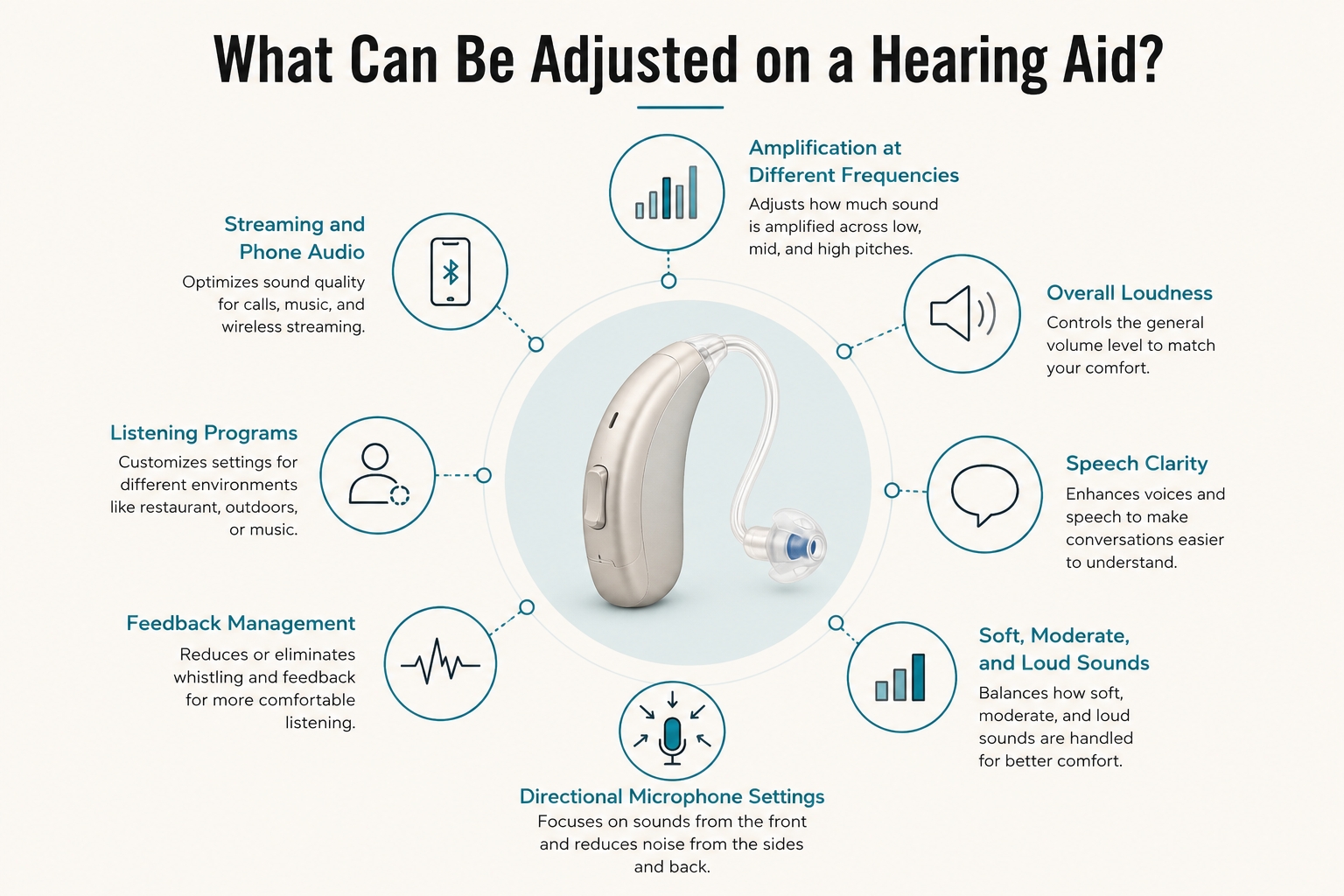
What Can Be Adjusted on a Hearing Aid?
The exact options depend on the hearing aid model and technology, but modern devices can offer considerable flexibility.
Your registered hearing aid practitioner may be able to adjust:
- amplification at different frequencies
- overall loudness
- speech clarity
- soft, moderate, and loud sound levels
- background noise management
- directional microphone settings
- feedback or whistling management
- specialized listening programs
- streaming and phone audio
The objective is to find a balance where speech is accessible without making everyday sounds unnecessarily uncomfortable.
Why Do My New Hearing Aids Sound Too Loud?
If you have lived with hearing loss for some time, your brain may have become accustomed to receiving less sound.
When hearing aids restore access to sounds you have been missing, ordinary noises can suddenly seem surprisingly noticeable. Running water, footsteps, paper, dishes, traffic, and even your clothing may sound louder than you remember.
Some of this can be part of the adjustment process. Your brain needs time to become familiar with the increased amount of auditory information it is receiving.
However, hearing aids should not be painfully loud. If certain sounds are consistently uncomfortable, tell your hearing care provider rather than simply stopping wearing your devices.
Why Do Hearing Aids Sometimes Sound Sharp or Tinny?
A sharp or tinny quality can occur when hearing aids provide access to higher-frequency sounds that you have not heard clearly for some time.
These frequencies contain important information for understanding speech, particularly consonants. Reducing them too aggressively may make the hearing aids more comfortable initially but could also reduce speech clarity.
This is why fine-tuning requires balance. Your practitioner can consider both comfort and your ability to understand speech when making adjustments.
Your perception may also change as you become accustomed to hearing these sounds again.
Why Does My Own Voice Sound Strange With Hearing Aids?
Your own voice is one of the first things you may notice after getting hearing aids. It can initially sound louder, deeper, hollow, or simply unfamiliar.
Several factors can contribute to this sensation, including the physical fit of the hearing aid or ear mould, amplification settings, and changes in how you hear your own voice.
Do not assume that you simply have to tolerate it. Tell your registered hearing aid practitioner exactly what you are experiencing. Changes to the fitting or programming may improve the sound.
Can Hearing Aids Be Adjusted for Background Noise?
Yes. Many modern hearing aids include technology designed to help manage challenging listening environments.
Directional microphones can help the hearing aids focus more effectively on speech coming from particular directions. Noise-management features may reduce the prominence of steady background sounds.
However, hearing aids cannot completely eliminate background noise while leaving every voice perfectly clear. Restaurants, parties, and group conversations remain some of the most demanding listening situations.
Fine-tuning can help your devices perform more appropriately in these environments, and your practitioner can also recommend communication strategies to make conversations easier.
How Do You Know What Hearing Aid Settings Need to Change?
Be as specific as possible about what is not working.
Saying, “My hearing aids don’t sound right,” gives your practitioner less information than describing the situation in which the problem occurs.
For example:
“Women’s voices sound too sharp.”
“I can hear people in restaurants, but I still can’t understand the words.”
“Cutlery and dishes are uncomfortably loud.”
“My television sounds clear, but conversation in the car is difficult.”
“My own voice sounds hollow.”
These details help your practitioner identify what may need to be adjusted.
Should You Adjust Hearing Aids Yourself?
Many hearing aids allow you to make simple everyday adjustments through buttons, remote controls, or smartphone apps. Depending on your devices, you may be able to change the volume, select a listening program, or adjust certain sound preferences.
These controls are useful for temporary changes in different environments.
Professional fine-tuning is different. Your registered hearing aid practitioner can make more detailed programming changes based on your hearing loss and how the hearing aids are performing.
If you find yourself constantly changing the volume or struggling with the same listening situation every day, it may be better to schedule a follow-up appointment rather than repeatedly compensating with your app.
How Often Should Hearing Aids Be Fine-Tuned?
There is no single schedule that works for everyone.
New hearing aid users may require several adjustments as they become accustomed to their devices and discover how they perform in different environments. After the initial adjustment period, additional fine-tuning may be needed if your hearing changes or you begin experiencing new listening difficulties.
Regular hearing assessments are also important because hearing can change over time. Settings that worked well several years ago may no longer match your hearing needs.
A change in hearing aid performance does not always mean programming is the problem. Earwax, blocked microphones, worn components, poor physical fit, or other maintenance issues can also affect sound quality.
What Should You Track Before a Fine-Tuning Appointment?
You do not need to understand hearing aid technology to provide useful feedback. Pay attention to situations where hearing feels particularly good or difficult.
Before your appointment, consider noting:
- where you were when the problem occurred
- whether the environment was quiet or noisy
- what you were trying to hear
- whether speech was too quiet or simply unclear
- which sounds seemed too loud
- whether the problem affected one or both hearing aids
A few specific examples can be more useful than trying to remember every listening problem you experienced since your last appointment.
Can Fine-Tuning Make Hearing Aids More Comfortable?
Often, yes.
Comfort involves more than the physical feeling of a hearing aid in your ear. Sound should also be comfortable.
If your hearing aids repeatedly make you want to take them out, something deserves attention. The issue could involve programming, physical fit, earwax, device maintenance, or the amount of time you have had to adjust to amplification.
Your hearing care provider can help determine what is happening rather than expecting you to solve the problem yourself.
What If My Hearing Aids Still Aren’t Helping?
If you are consistently wearing your hearing aids and still struggling to understand speech, particularly in everyday environments, speak with your hearing care provider.
Your hearing aids may require additional programming. Your hearing may also have changed since your previous assessment, or another issue may be affecting performance.
Sometimes expectations also need to be discussed. Hearing aids can provide significant benefits, but they cannot restore the auditory system to exactly how it functioned before hearing loss.
The important question is whether your devices are providing the best hearing possible for your individual needs.
Hearing Aid Fine-Tuning at Melody Hearing Clinic
Successful hearing aid fitting does not end when you receive your devices. Follow-up care and fine-tuning are important parts of getting comfortable with hearing aids and making them work effectively in your everyday life.
At Melody Hearing Clinic, our registered hearing aid practitioners listen to what you are experiencing, not just what appears on your hearing test. If restaurants are difficult, your own voice sounds strange, or certain sounds are uncomfortable, those details can help guide your care.
With eight hearing clinics across Alberta, Melody Hearing Clinic provides ongoing hearing aid support and personalized adjustments as your hearing needs change.
You should feel comfortable telling us what is and is not working. Fine-tuning is a collaborative process, and sometimes small adjustments can make a meaningful difference in how confidently you hear throughout your day.