
How loud is too loud for your ears? Sounds below 70 dBA pose no known risk of hearing loss, regardless of how long you are exposed, according to Health Canada. As sound levels rise above 70 dBA, the duration of exposure becomes increasingly important.
For example, a normal conversation is around 60 dB, while heavy traffic can reach approximately 85 dB. At higher sound levels, safe listening time decreases quickly.
Understanding decibels can help you recognize potentially harmful environments and make informed decisions about when to turn down the volume, move away from a loud sound, or use hearing protection.
What Are Decibels?
Decibels (dB) are units used to describe sound intensity. The decibel scale is logarithmic, which means a relatively small increase in the number represents a much larger increase in sound intensity.
This is why the difference between 80 dB and 100 dB is much more significant than the numbers may initially suggest.
Everyday sounds cover a wide range of decibel levels. Normal conversation is approximately 60 dB, while an airplane taking off can reach approximately 140 dB.
Understanding the decibel scale makes it easier to recognize when your hearing may need protection.
Source: World Health Organization, “Deafness and hearing loss: Safe listening,” 2026.
https://www.who.int/news-room/questions-and-answers/item/deafness-and-hearing-loss-safe-listening
How Many Decibels Are Safe for Your Hearing?
There is no single decibel number that separates every safe sound from every dangerous one. Both volume and exposure time matter.
Health Canada states that sounds below 70 dBA pose no known risk of hearing loss, regardless of exposure duration. Once sound levels rise above 70 dBA, the amount of time you spend around the sound becomes increasingly important.
WHO recommends keeping average personal listening levels below 80 dB. At 80 dB, WHO’s safe-listening guidance allows up to 40 hours of exposure per week. At 90 dB, that drops to about four hours per week.
The louder the sound becomes, the less time you can safely spend around it.
Sources: Health Canada, “Noise and sound: Hearing loss and tinnitus,” 2024.
https://www.canada.ca/en/health-canada/services/noise-your-health/hearing-loss-tinnitus.html
World Health Organization, “Deafness and hearing loss: Safe listening,” 2026.
https://www.who.int/news-room/questions-and-answers/item/deafness-and-hearing-loss-safe-listening
How Long Can You Safely Listen to Different Decibel Levels?
WHO provides the following examples to demonstrate how quickly safe listening time decreases as sound levels rise:
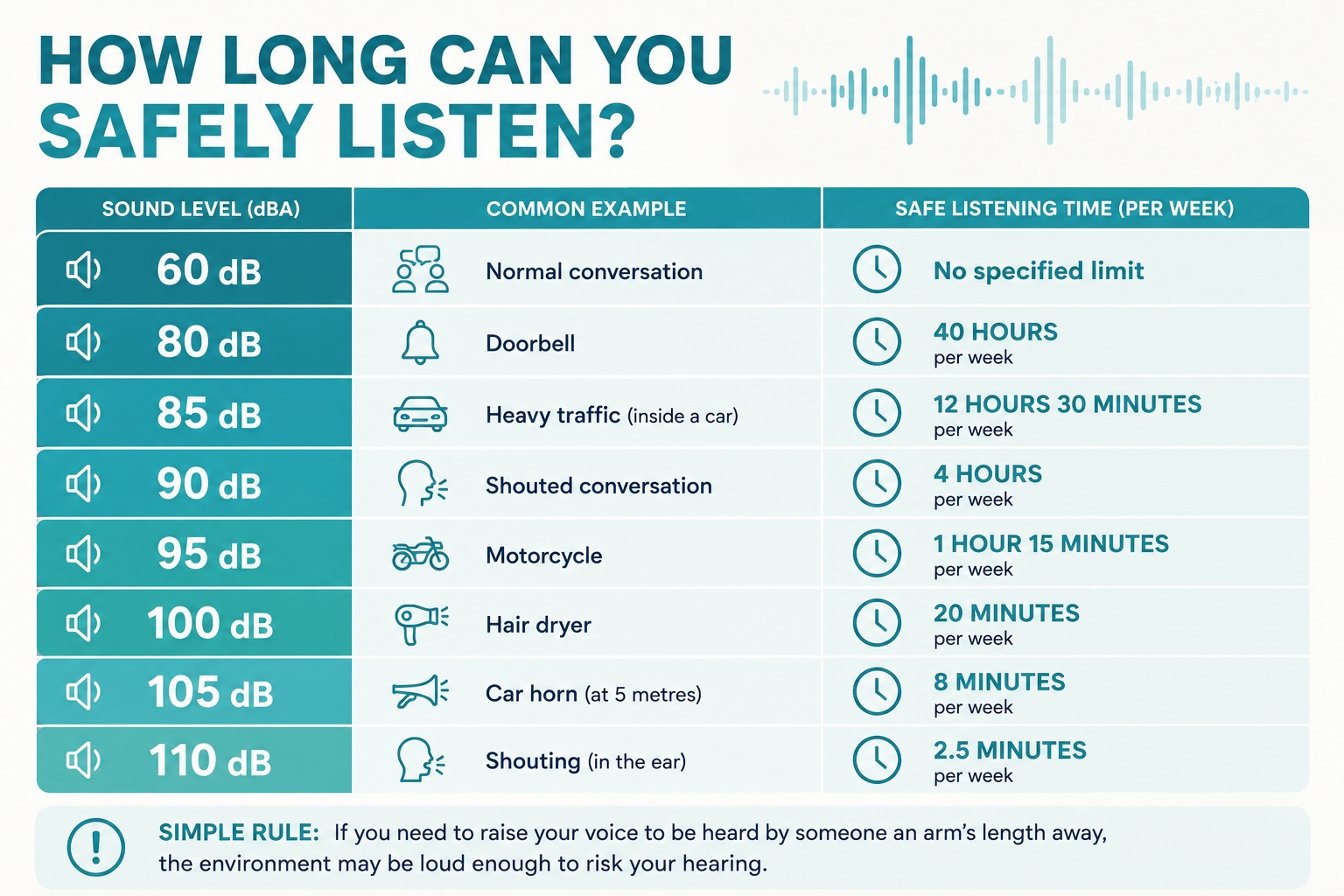
These examples show why duration matters just as much as volume. A sound that may present relatively little risk for a short period can become harmful when exposure continues.
Source: World Health Organization, “Deafness and hearing loss: Safe listening,” 2026.
https://www.who.int/news-room/questions-and-answers/item/deafness-and-hearing-loss-safe-listening
When Is a Sound Too Loud?
You do not always need a sound meter to recognize a potentially loud environment.
WHO suggests a simple test: if you need to raise your voice to be heard by someone standing about an arm’s length away, the environment may be loud enough that you should consider protecting your hearing.
You can also use a sound-level app or built-in smartphone features to monitor the approximate noise around you.
Pay particular attention to environments such as concerts, nightclubs, sporting events, construction sites, workshops, and other places where you may be exposed to high sound levels for extended periods.
How Can You Protect Your Hearing From Loud Noise?
Protecting your hearing does not mean avoiding music, events, tools, or other sounds you enjoy. It means managing how loud, how long, and how often you are exposed.
Simple ways to protect your hearing include:
-
Keep personal listening devices at a comfortable volume.
-
Take breaks from loud environments.
-
Move farther away from speakers and other sources of loud sound.
-
Wear properly fitted hearing protection in noisy environments.
-
Monitor sound levels when you are unsure how loud an environment is.
-
Give your ears time to recover after exposure to loud noise.
WHO also recommends keeping personal devices at no more than about 60% of maximum volume and using well-fitted noise-cancelling headphones when appropriate. Noise cancellation can reduce the need to increase your listening volume in a noisy environment.
Source: World Health Organization, “Deafness and hearing loss: Safe listening,” 2026.
https://www.who.int/news-room/questions-and-answers/item/deafness-and-hearing-loss-safe-listening
What Are the Signs That Noise May Be Affecting Your Hearing?
Noise-related hearing changes are not always immediately obvious. Damage can develop gradually, particularly when loud noise is part of your work, hobbies, or regular entertainment.
You may notice ringing or buzzing in your ears after being somewhere loud. Sounds may temporarily seem muffled, or you may have more difficulty understanding conversations, particularly when there is background noise.
Persistent tinnitus, difficulty hearing higher-pitched sounds, or increasing trouble following conversations are reasons to have your hearing evaluated.
If you notice a sudden change in your hearing, seek prompt medical attention rather than waiting to see whether it improves on its own.
Protect Your Hearing Before You Notice a Change
Hearing protection is most effective when you use it before damage occurs.
Understanding decibels gives you a practical way to make decisions about everyday sound. When noise becomes louder, reduce the amount of time you are exposed, increase your distance from the sound source, or use appropriate hearing protection.
At Melody Hearing Clinic, our registered hearing aid practitioners can help you better understand your hearing and discuss hearing protection based on your lifestyle and listening environments.
If you are concerned that loud noise may already have affected your hearing, a hearing test can help identify changes and give you a clearer picture of your current hearing health.