
Artificial intelligence is changing how people find information, and in many ways that is a good thing. You can ask an AI chatbot to explain a medical term, summarize the difference between two types of hearing loss, or help you figure out what questions to bring to your appointment. For general information, AI can be a genuinely helpful starting point.
But there is a meaningful gap between getting useful background information and getting an accurate picture of your own hearing health. And that gap matters more than most people realize.
What AI Tools Can and Cannot Tell You About Hearing Loss
AI chatbots like ChatGPT are trained on enormous amounts of text from across the internet. That means they can explain what sensorineural hearing loss is, describe the common signs of auditory processing difficulty, or outline the difference between conductive and mixed hearing loss. For someone who has just received a diagnosis and wants to understand it better, that kind of explanation can be genuinely useful.
Where AI falls short is the moment you move from general information to your specific situation.
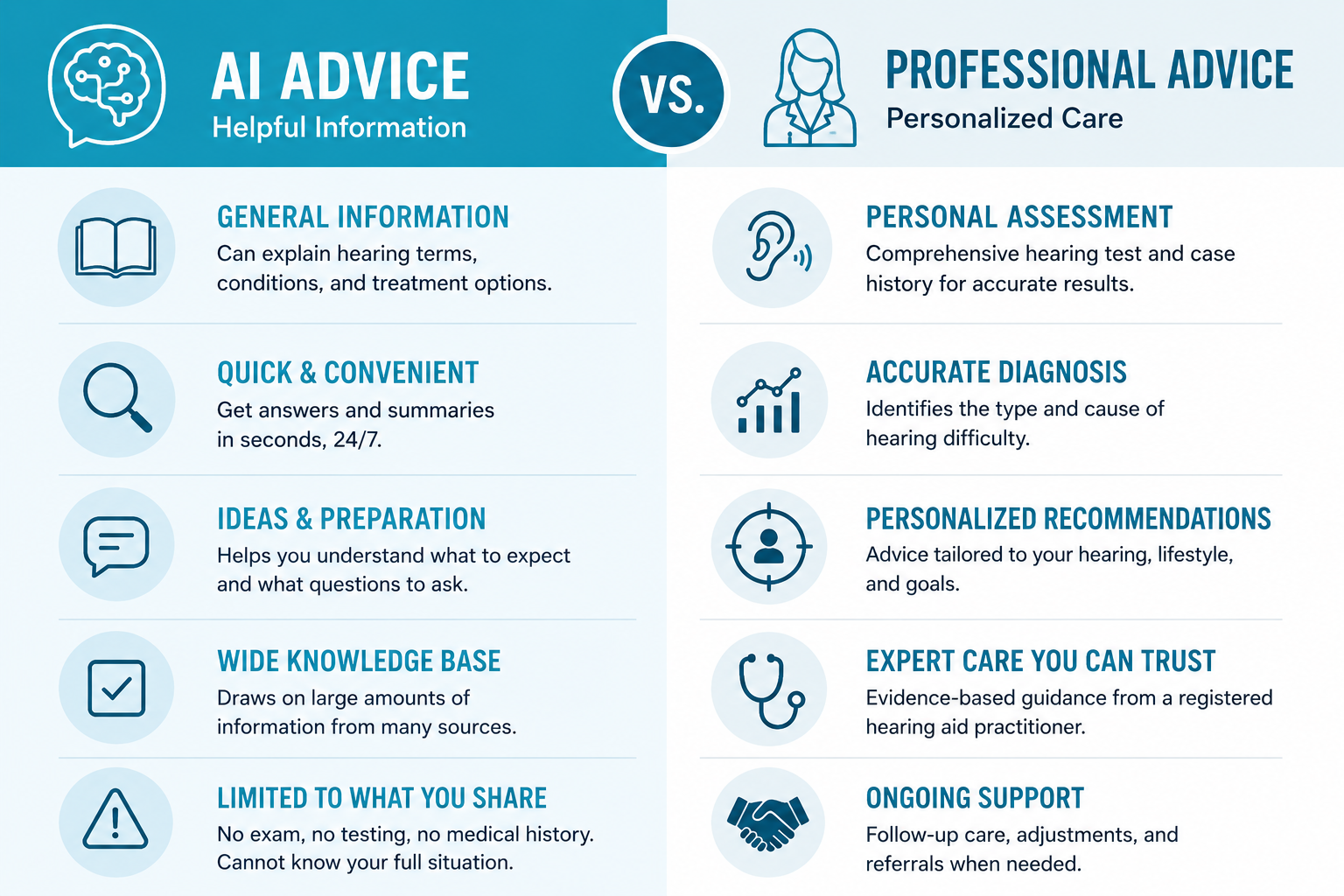
When you describe your symptoms to an AI, it has no way to examine you, run a hearing test, or gather the clinical data needed to form a reliable picture of what is actually happening. It can pattern-match your description against information it has been trained on and offer a few possibilities. But those possibilities are not a diagnosis, and the confidence with which some AI tools deliver information can make it easy to forget that distinction.
Why AI Hearing Advice Can Be Misleading
Hearing difficulties rarely have a single obvious cause. The same symptom, like struggling to follow conversations in noisy rooms, can point toward several different underlying issues: sensorineural hearing loss, auditory processing disorder, the early stages of age-related hearing change, or even something unrelated to the ear itself. Determining which applies to a specific person requires testing, not text.
There is also the issue of what AI cannot account for: your medical history, your medications, how long the problem has been developing, whether it affects one ear or both, and dozens of other factors that a registered hearing aid practitioner would consider before drawing any conclusions.
AI giving you a confident-sounding explanation of your symptoms is not the same as a professional giving you an informed assessment of your hearing health. The output might look similar on screen. The reliability is not.
Using AI as a Research Tool, Not a Hearing Health Diagnosis
None of this means you should avoid using AI entirely when you have questions about your hearing. Used well, it can help you feel more prepared and less anxious before an appointment. Looking up what a pure-tone audiogram involves, or asking what questions to raise with your practitioner, are perfectly reasonable uses of these tools.
The key is knowing where the usefulness ends. AI can inform you. It cannot assess you. And when it comes to something as important as your hearing, that is a distinction worth holding onto.
When to See a Registered Hearing Aid Practitioner Instead of Asking AI
If you find yourself typing your hearing symptoms into an AI chatbot hoping for clarity, that is usually a sign you are ready to speak to someone who can actually help. A registered hearing aid practitioner can run a proper assessment, explain what the results mean in plain language, and give you a clear sense of what your options are, whether that includes hearing aids, hearing protection, or a referral onward.
The process is straightforward, and knowing what is actually going on is almost always less stressful than cycling through possibilities online.
Some things worth bringing to a professional rather than an AI include: any sudden change in your hearing, difficulty following speech in quiet environments, a sense that one ear is performing differently from the other, ringing or buzzing sounds that do not go away, and any hearing concern that has been bothering you for more than a few weeks.
At Melody Audiology, our registered hearing aid practitioners offer comprehensive hearing assessments and take the time to walk you through your results. We offer a complimentary hearing test for individuals over 55 across our eight Alberta locations.
When you are ready for a real answer, we are ready to help.
Book an assessment at Downtown Edmonton, Mill Woods, South Edmonton, Sherwood Park, St. Albert, Calgary, Leduc, or Windermere.